The UK Budget offers a tangible promise to eligible households: a £100 energy payment from January. But the money arrives against a less comfortable backdrop. Inflation is forecast to remain higher than previously expected, while the recovery in purchasing power looks slow. The difference between immediate help and a lasting improvement in living standards is the story behind the announcements.
Contents
The Budget delivered on 28 October 2026 deserves to be read through that distinction. A payment can make a difficult month easier. A sustained rise in living standards requires income to buy more after bills and taxes have been paid. The two can happen together, but one does not guarantee the other.
The £100 payment helps, but eligibility matters
The proposed Household Energy Payment is aimed at main homes in council tax bands A–D in England. Payments are due to begin from January 2027, with up to 20 million households eligible. Empty properties and second homes are excluded, and full eligibility criteria will follow. Devolved governments will receive additional funding and decide their own support.
It is also a one-off payment. That makes it useful help with a particular bill, rather than an annual improvement that can safely be carried forward. There is a similar distinction in the plan to remove gas standing charges: the government says system costs would move into unit rates. The eventual effect would therefore depend on how much gas a household uses. Removing one part of a bill does not necessarily remove its underlying cost.
Other measures operate on different timetables. The Treasury’s Budget document extends the electricity VAT cut to July 2027 and continues the 5p fuel-duty cut and freeze to 1 July 2027. A driver may welcome the decision on duty, but it does not fix the price displayed on the forecourt. A household without a car will experience that announcement differently. Adding every headline measure into a single supposed saving would obscure those differences.
The inflation forecast explains the unease
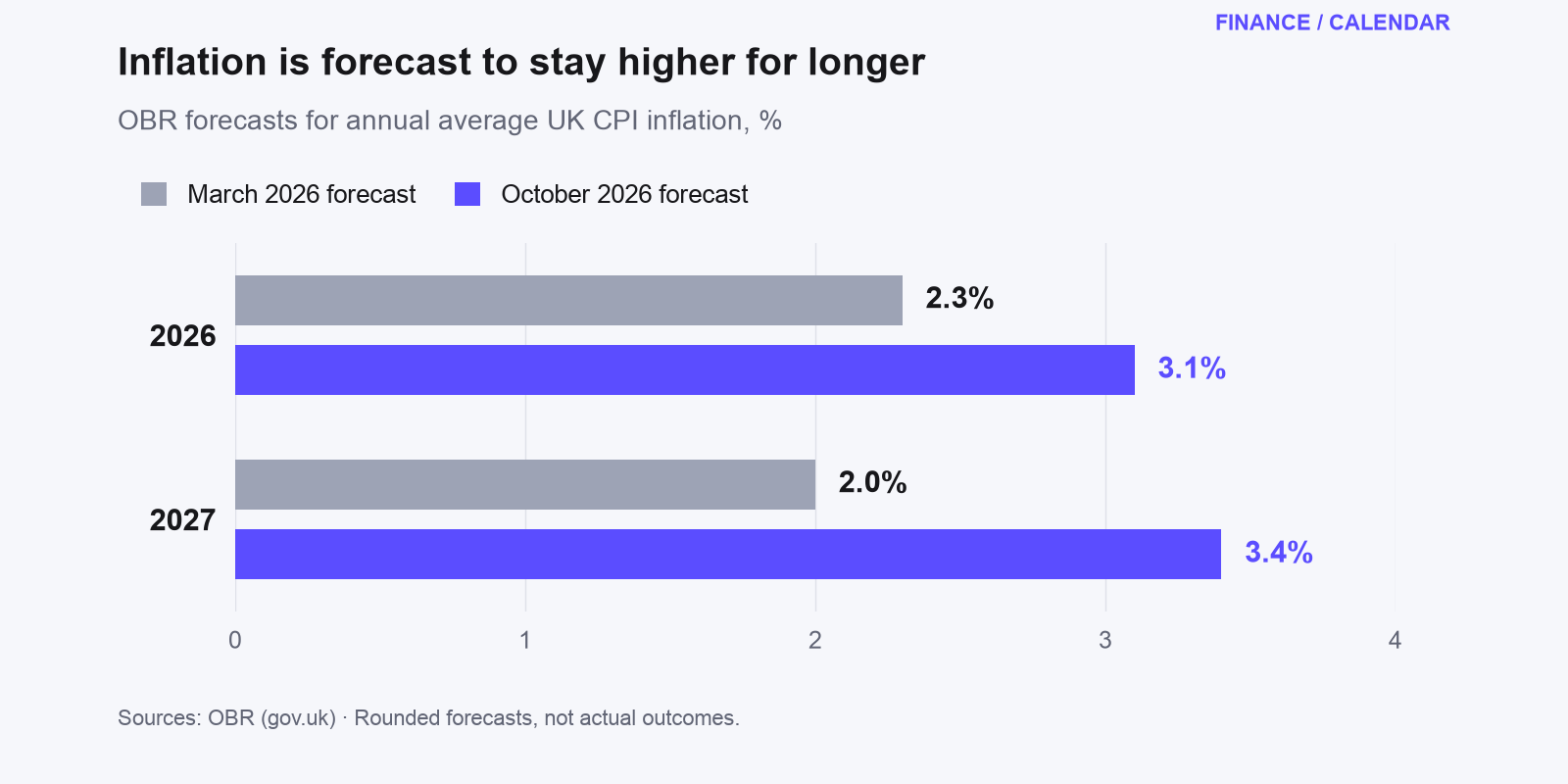
In March, the Office for Budget Responsibility forecast annual average inflation of 2.3% for 2026 and 2.0% for 2027. Its October forecast puts those figures at 3.1% and 3.4%. The chart compares the published forecasts; these are estimates of future outcomes, not actual inflation readings. Sources: March forecast, Table 2.2 and October forecast, Table A.1.
Lower inflation means prices rise more slowly; it does not mean previous price increases disappear. Crucially, the OBR estimates that the Budget’s measures themselves slightly reduce inflation in 2027. The wider worsening in the outlook should not be presented as something the Budget caused.
The watchdog expects real household disposable income per person to grow by around 0.75% a year over the final four forecast years. That is income adjusted for prices and population, and an economy-wide average rather than a forecast for a particular family. It describes a recovery with limited momentum.
A pay rise is only part of the calculation
Pay offers another way to understand the gap between an announcement and the experience of receiving it. The Low Pay Commission’s 2027 advice recommends a 50p increase in the National Living Wage for workers aged 21 and over, taking it to £13.21 from 1 April 2027. That is a 3.9% increase in the hourly rate. It applies to a particular group of workers, not to everyone’s salary.
An hourly increase also leaves other questions open: how many hours someone works, what happens to their rent and bills, and how much of their income remains after tax. It would be misleading to subtract a national inflation forecast from that hourly increase and call the result every worker’s improvement in living standards. The comparison is useful as context, not as a personal payslip calculation.
What to watch next
The recent record is more mixed than a story of uninterrupted decline. The ONS reported that real household disposable income per person rose 1.0% in the second quarter of 2026, following a 0.8% fall in the first. Those are recorded quarterly changes, published before the Budget, rather than forecasts or an effect of its policies.
The next tests are practical: publication of the energy payment’s full eligibility rules, the start of payments from January, and the income changes due in April. Alongside those dates, the Finance Calendar tracks the inflation, earnings and economic releases that show whether the wider outlook is improving. For households, the question is whether relief develops into a sustained increase in what their money can buy.
About Finance Calendar
Economic release schedules, market calendars and practical guides to using the data.
About the site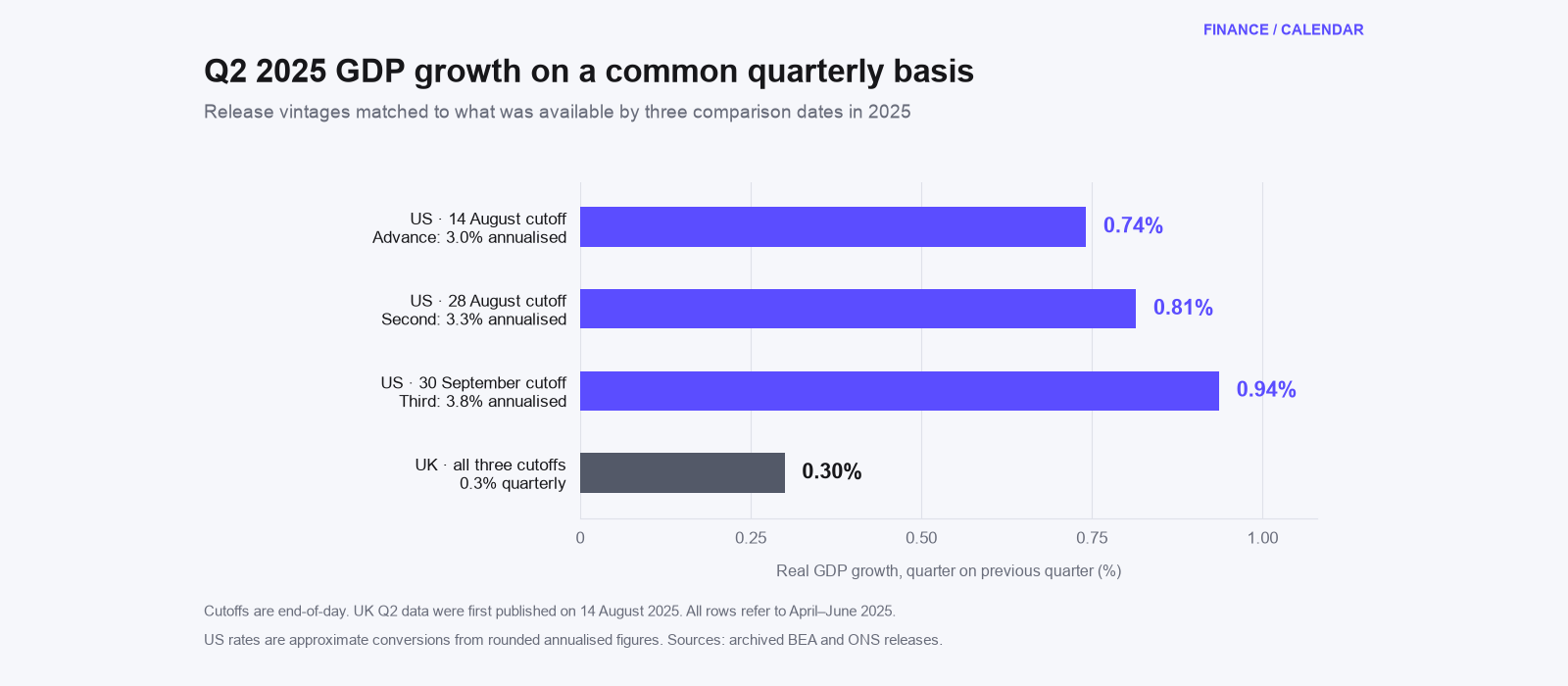
US vs UK GDP growth: comparing annualised and quarterly rates
A worked Q2 2025 comparison shows how to convert US and UK GDP growth, match publication vintages and avoid confusing a growth revision with a change in GDP levels.
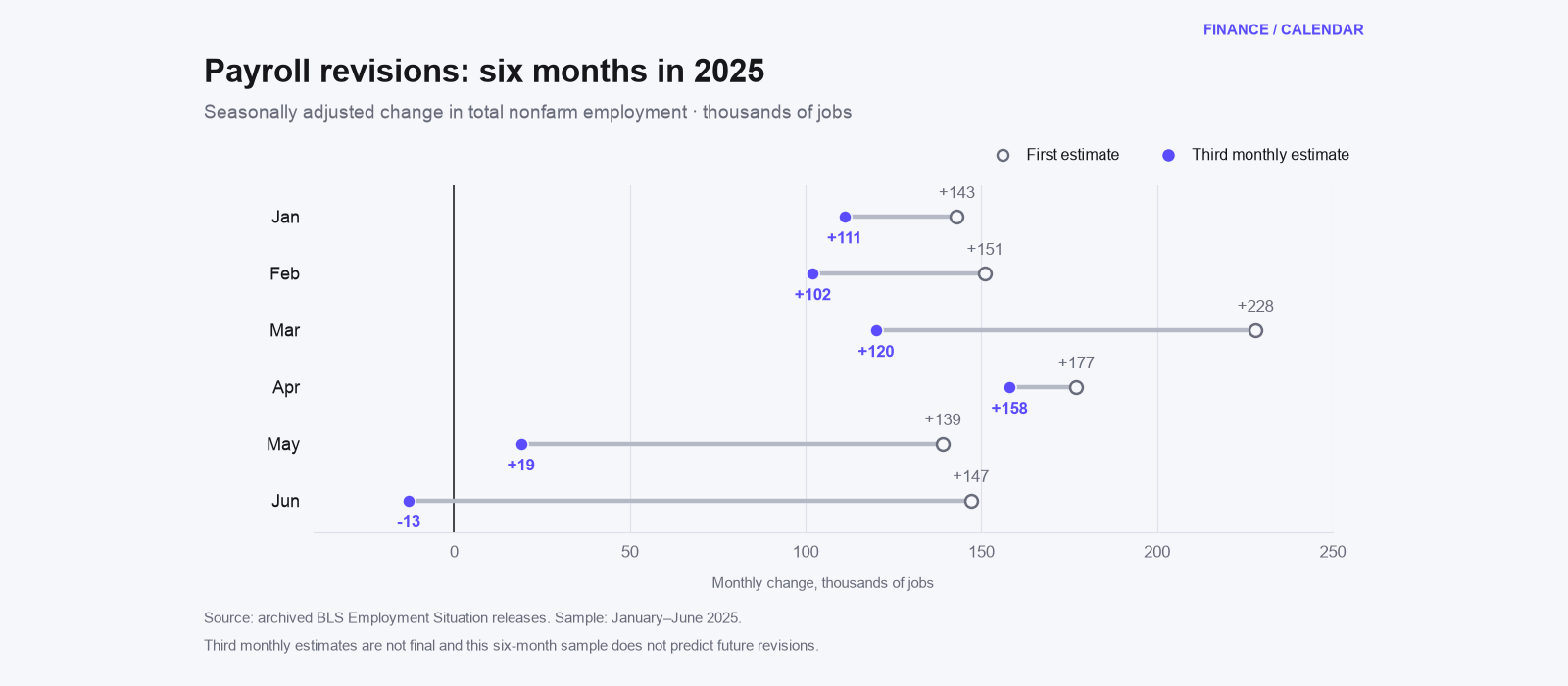
US payroll revisions: what changed in the first half of 2025
A source-linked study of six months of US payroll estimates: what changed between the first and third releases, how to reproduce it, and why the limits matter.