The next scheduled Federal Open Market Committee meeting is on 8–9 December 2026. Comparing its decision time with the official release calendars reveals an uneven information window: November’s jobs report is scheduled to arrive beforehand, while November’s CPI and PCE inflation reports are scheduled to arrive afterwards. This is a comparison of public publication schedules, not a prediction of the decision. The meeting dates and its association with economic projections are confirmed in the Federal Reserve’s FOMC calendar.

Contents
Across four selected report families—Employment Situation, CPI, Personal Income and Outlays, and national GDP—five new publications are scheduled between 1 November and the decision. They fall on four dates, because two BEA reports share one release time. The useful finding is the mismatch between reference periods: the latest scheduled jobs report covers November, but the latest scheduled consumer-inflation reports cover October.
The five selected publications scheduled before the decision
We use 9 December at 2 p.m. Eastern Time as the comparison point. The Fed’s December calendar lists the meeting at that time, followed by a 2:30 p.m. press conference. Its meeting-schedule announcement explicitly identifies both times as Eastern. This public statement time is not a claim about the Committee’s internal information cutoff.
| Publication and period | Scheduled release | Time before statement |
|---|---|---|
| Employment Situation: October | 6 November, 8:30 a.m. ET | 33 days, 5½ hours |
| CPI: October | 10 November, 8:30 a.m. ET | 29 days, 5½ hours |
| GDP: Q3, second estimate | 25 November, 8:30 a.m. ET | 14 days, 5½ hours |
| Personal Income and Outlays: October | 25 November, 8:30 a.m. ET | 14 days, 5½ hours |
| Employment Situation: November | 4 December, 8:30 a.m. ET | 5 days, 5½ hours |
This is an incremental watchlist from 1 November, not a list of everything available since the previous FOMC meeting. The Q3 GDP advance estimate and September Personal Income and Outlays report were already released on 29 October. They provide an earlier baseline and are excluded from the five forthcoming publications.
Why the jobs and inflation months will not line up
Reading only the calendar month of publication obscures what a report measures. A jobs release in December need not describe December. In this window, the 4 December release covers November; the 10 November CPI release covers October. Assuming schedules remain unchanged, those will be the newest reference months for these two series at the public statement time. Our US jobs report guide and US CPI guide explain the recurring releases.
There is also a distinction within the jobs report. Payroll employment, hours and earnings come from the establishment survey, while unemployment comes from the household survey. Their coverage and reference periods differ. Treating the report as one instantaneous reading of every worker would overstate what it measures. BLS explains these survey differences.
For a reader preparing a December briefing, the practical question is therefore: which period does each number describe? Comparing November employment with October inflation can be legitimate, provided that difference is explicit. Calling both “the latest November data” would hide the mismatch.
The next CPI release misses the statement by 18½ hours
November CPI is scheduled for 10 December at 8:30 a.m. ET. Our timestamp calculation places it 18 hours and 30 minutes after the statement. November Personal Income and Outlays is scheduled for 23 December, alongside the third estimate of Q3 GDP. These are scheduled public releases after the decision, not missing rows in the pre-decision watchlist. BLS December calendar; BEA calendar.
PCE and CPI should not be substituted for one another merely to fill that gap. BEA explains that the indexes differ in construction and coverage. Its core PCE index excludes food and energy and appears within Personal Income and Outlays. The calendar can identify when these measures become public; it cannot establish what either forthcoming number will be. BEA inflation guide; BEA core PCE explanation. See also our US PCE report guide.
GDP adds a new estimate, not a new quarter
The 25 November GDP publication updates Q3, covering July–September. It is not a first reading of Q4. BEA’s second estimate incorporates more complete source information than the advance estimate; the third estimate follows later. A new publication date can therefore change an earlier period’s estimate without adding another quarter. BEA GDP overview; BEA explanation of estimate vintages.
The same caution applies to the jobs timeline: later payroll publications can revise earlier monthly estimates. Preserve the initially reported value and subsequent revisions separately when comparing what was known at different dates. BLS describes its regular monthly revision process in the Employment Situation FAQ. This article counts publication opportunities, not independent economic signals or final observations.
Other scheduled arrivals around this core watchlist
The broader calendar also contains September JOLTS on 3 November, preliminary Q3 productivity on 5 November and October PPI on 13 November. December adds October JOLTS on the 1st and revised Q3 productivity on the 8th. International trade reports are scheduled for 4 November and 8 December. These show why the five-publication count must stay attached to its four-family scope. Sources: BLS November, BLS December and BEA.
Method and limits
We matched the four selected report families to official schedules checked on 1 November 2026, retained each reference period, and compared timezone-aware timestamps with the scheduled statement. A positive “time before” means elapsed time to that public event, including weekends. All future releases shown here occur during Eastern Standard Time, UTC−5. BEA’s official calendar feed supplies UTC timestamps for its releases.
This is a bounded public-calendar comparison. It does not inventory all economic information, establish when policymakers incorporate a report, or describe internal data access. Schedules may change. Recheck the linked publishers before relying on a date; no forecasts, consensus figures or forthcoming results are assumed. Use our FOMC meetings guide for the wider schedule. This research explains information timing and offers no recommendation about rates or investments.
About Finance Calendar
Economic release schedules, market calendars and practical guides to using the data.
About the site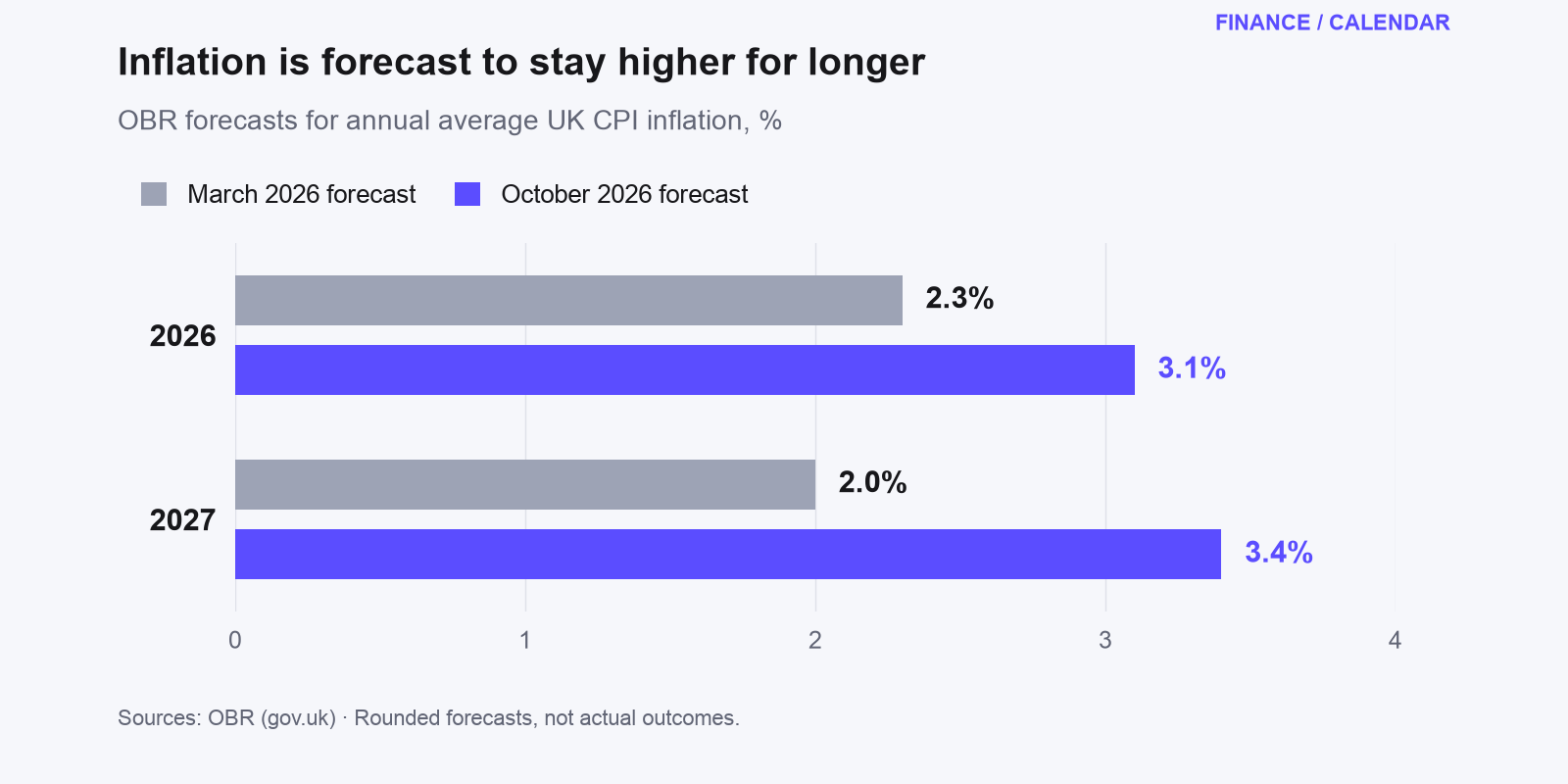
UK Budget 2026: why households may still feel squeezed
A £100 energy payment offers help to eligible households, but higher inflation forecasts explain why lasting relief may take longer. We examine the numbers, eligibility and dates that matter.
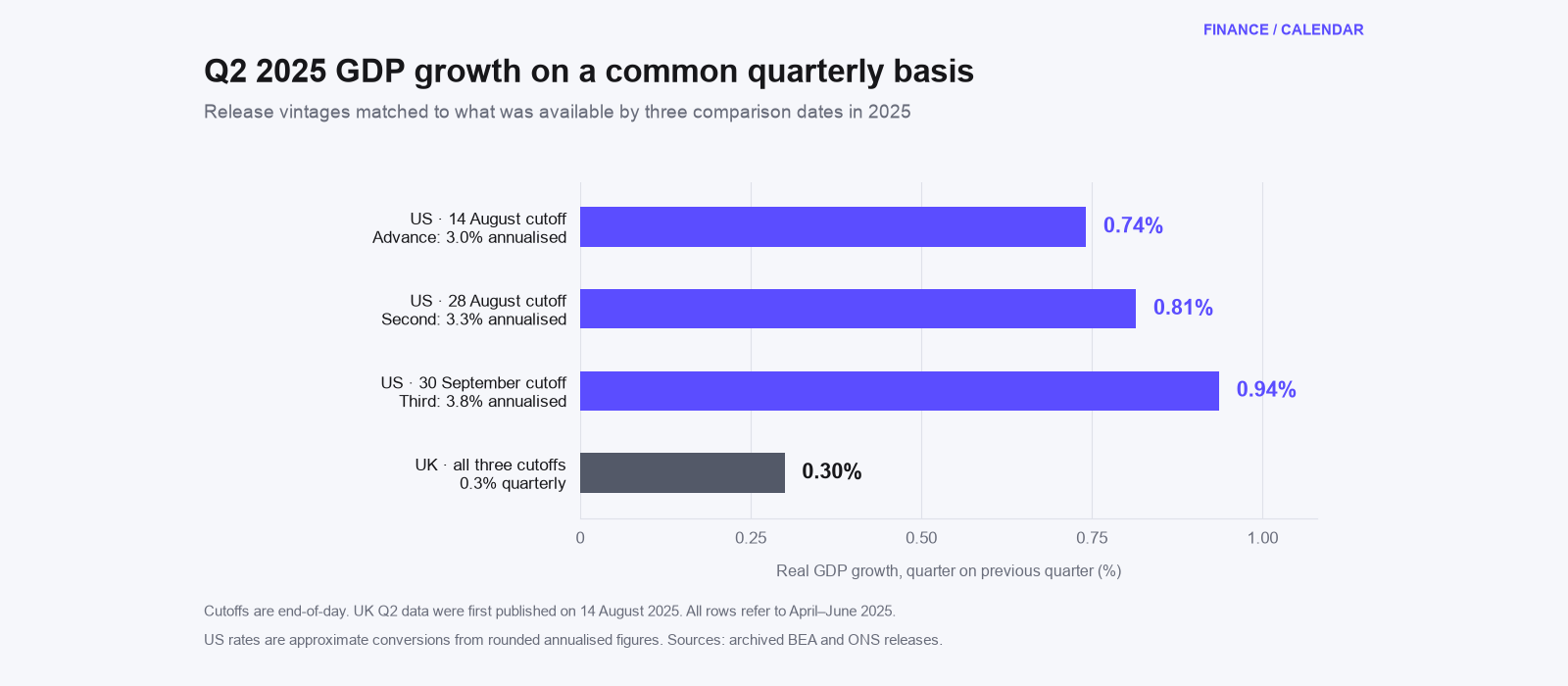
US vs UK GDP growth: comparing annualised and quarterly rates
A worked Q2 2025 comparison shows how to convert US and UK GDP growth, match publication vintages and avoid confusing a growth revision with a change in GDP levels.