Economic calendar API for apps and AI
Every market-moving event as clean data: the date, the time and the impact, plus forecasts and results for headline measures. Connect your app, AI assistant or trading tool in minutes.
Free plan available. Cancel online at any time.
What people build with it.
One calendar of market-moving events, read by your own software.
Apps, dashboards and briefings
Put the week’s events, forecasts and results in your own product, dashboard, channel or spreadsheet, in your own time zone.
Quickstart · REST referenceAI assistants and research
Connect ChatGPT or Claude and ask what is due this week, what the market expects and what was published.
Connect an assistantTrading tools and news filters
Ask for a currency pair, a single currency or gold and get the high-impact events that affect it. A ready-made filter for MetaTrader 4 and 5 is included.
MetaTrader news filter · Forex calendar APIWhat’s in the calendar.
Put release dates, consensus forecasts and reported results into your app, research workflow or AI assistant.
Economic releases
Release schedules, forecasts across 10 economies, and expanded consensus, actual and prior data across 12 US series.
Central bank decisions
Rate decisions and monetary-policy meeting schedules.
Market holidays
Exchange closures and recorded early closes.
Selected crypto events
Token unlocks, DAO votes, network upgrades and supply projections.
- Stay in sync. Stable IDs and recorded changes help you update an existing calendar.
- Fit your workflow. Filter by country, date, series and impact. Use JSON, CSV or ICS.
- Keep the context. Use consensus, actual and prior figures with reporting months, timing precision and field-level source evidence.
Three ways to connect.
Use the same calendar through the tools you already have.
Explore and export
Search releases, save your views and export selected or filtered records in the Data explorer.
Open the Data explorerConnect an AI assistant
Use hosted MCP with a compatible client, or the local MCP server, to query release dates, forecasts, results and source evidence with your API key.
Connect ChatGPT or ClaudeBuild your integration
Use the REST API, CLI or Python client for a dashboard, country watchlist or daily market briefing.
REST setup · CLI and Python · Trading tools and botsLinked keys and MCP data calls share your account allowance. Clients have tested GitHub downloads and a public source repository.
Choose a plan.
All paid plans include API access. Starter is US$4.99/month; choose Build for higher request limits, or Scale for the complete current dataset download. Every paid plan includes release figures, integration tools and official economic history. Choose how far back you need to go.
Starter
RecommendedBuild with release figures and integration tools.
US$4.99 / month
Monthly plan. Cancel online anytime.No annual commitment. Keep access until your paid month ends.
Billed monthly. Renews monthly until cancelled. Applicable tax included.
Build private apps, research tools and automated watchlists.
- 1 year of economic history
- Personal projects, internal tools and private development
- Forecast coverage for 60 supported measures across 10 economies
- Recorded US consensus, actual and prior figures across 12 headline series
- 250 API requests per day
- 5,000 API requests per calendar month
- Data explorer, saved views and filtered or selected CSV/JSON exports
- REST, MCP, CLI and Python access
- Up to three active keys sharing one account allowance
Create an account and confirm your email, or sign in, then complete secure payment. Account creation does not charge you.
Build
Connect a growing app.
US$9.99 / month
Monthly plan. Cancel online anytime.No annual commitment. Keep access until your paid month ends.
Billed monthly. Renews monthly until cancelled. Applicable tax included.
For apps, dashboards and research tools that need a higher daily allowance.
- 10 years of economic history
- Customer-facing commercial apps included
- 100,000 API requests per day
- REST, MCP, CLI and Python access with the same recorded fields and source evidence
- Data explorer, saved views and filtered or selected CSV/JSON exports
- Up to three active keys sharing one account allowance
Create an account and confirm your email, or sign in, then complete secure payment. Account creation does not charge you.
Scale
Complete dataset includedTake the complete dataset with you.
US$29 / month
Monthly plan. Cancel online anytime.No annual commitment. Keep access until your paid month ends.
Billed monthly. Renews monthly until cancelled. Applicable tax included.
For complete dataset downloads and integrations with a larger daily audience.
- All available economic history
- Customer-facing commercial apps included
- 1,000,000 API requests per day
- Full dataset JSON export included. Download the complete current snapshot, with recorded series, exchanges, source evidence and the retained change log.
- Data explorer, saved views and filtered or selected CSV/JSON exports
- Up to three active keys sharing one account allowance
Create an account and confirm your email, or sign in, then complete secure payment. Account creation does not charge you.
Plans renew each month, or each year on annual billing, until you cancel. Cancel online at any time. Applicable tax included. Creating an account does not charge you.
Each measure lists its available dates. Check history coverage.
History you can build with
Explore 5,082 official observations across 21 measures. Build longer-run charts and research views with exact values and source evidence.
Dated source editions identify verified initial figures and later estimates. Published survey aggregates add historical forecasts, separate from event consensus.
Figures are the current official values, including revisions.
Historical coverage: selected examples
- UK CPI inflationUK Office for National Statistics
- Jan 2006Oct 2026
- US nonfarm payrollsUS Bureau of Labor Statistics
- Jan 2006Oct 2026
- UK monthly GDPUK Office for National Statistics
- Jan 2006Sep 2026
- Canada retail salesStatistics Canada
- Feb 2017Sep 2026
See the full set of indicators
Your plan sets how far back you can query.
Compare every plan.
See what each plan includes, from schedules to the complete dataset.
| What’s included | Free Developer | StarterRecommended | Build | Scale |
|---|---|---|---|---|
| Price and limits | ||||
| Price | US$0No card | Monthly US$4.99Annual US$53.89 | Monthly US$9.99Annual US$95.90 | Monthly US$29.00Annual US$278.40 |
| Requests / UTC day | 10 | 250 | 100,000 | 1,000,000 |
| Requests / UTC month | 100 | 5,000 | No monthly cap | No monthly cap |
| Calendar records / response | Up to 20No pagination | Up to 500With pagination | Up to 500With pagination | Up to 500With pagination |
| Data | ||||
| Release schedules | Today through +6UTC | Full calendar | Full calendar | Full calendar |
| Calendar categories | Economic releasesand central banks | All categories | All categories | All categories |
| Release forecasts | No | Yes | Yes | Yes |
| Consensus, prior and actual | No | Yes | Yes | Yes |
| Release history | No | Yes | Yes | Yes |
| Official observation archive | No | 1 year | 10 years | All available |
| Tools | ||||
| Change feed and webhooks | No | Yes | Yes | Yes |
| News window | No | No | Yes | Yes |
| Market closures by currency | No | No | Yes | Yes |
| Formats | JSON | JSON, CSV, ICS | JSON, CSV, ICS | JSON, CSV, ICS |
| REST, CLI and Python | Yes | Yes | Yes | Yes |
| Hosted MCP and Data explorer | No | Yes | Yes | Yes |
| Complete dataset download | No | No | No | Yes |
| Use | ||||
| Customer-facing apps | No | No | Yes | Yes |
| Get started | Compare Free and paid responses | Choose Starter | Choose Build | Choose Scale |
Free DeveloperUS$0
| Feature | Free Developer |
|---|---|
| Price and limits | |
| Price | US$0No card |
| Requests / UTC day | 10 |
| Requests / UTC month | 100 |
| Calendar records / response | Up to 20No pagination |
| Data | |
| Release schedules | Today through +6UTC |
| Calendar categories | Economic releasesand central banks |
| Release forecasts | No |
| Consensus, prior and actual | No |
| Release history | No |
| Official observation archive | No |
| Tools | |
| Change feed and webhooks | No |
| News window | No |
| Market closures by currency | No |
| Formats | JSON |
| REST, CLI and Python | Yes |
| Hosted MCP and Data explorer | No |
| Complete dataset download | No |
| Use | |
| Customer-facing apps | No |
StarterRecommendedMonthly US$4.99Annual US$53.89
| Feature | Starter |
|---|---|
| Price and limits | |
| Price | Monthly US$4.99Annual US$53.89 |
| Requests / UTC day | 250 |
| Requests / UTC month | 5,000 |
| Calendar records / response | Up to 500With pagination |
| Data | |
| Release schedules | Full calendar |
| Calendar categories | All categories |
| Release forecasts | Yes |
| Consensus, prior and actual | Yes |
| Release history | Yes |
| Official observation archive | 1 year |
| Tools | |
| Change feed and webhooks | Yes |
| News window | No |
| Market closures by currency | No |
| Formats | JSON, CSV, ICS |
| REST, CLI and Python | Yes |
| Hosted MCP and Data explorer | Yes |
| Complete dataset download | No |
| Use | |
| Customer-facing apps | No |
BuildMonthly US$9.99Annual US$95.90
| Feature | Build |
|---|---|
| Price and limits | |
| Price | Monthly US$9.99Annual US$95.90 |
| Requests / UTC day | 100,000 |
| Requests / UTC month | No monthly cap |
| Calendar records / response | Up to 500With pagination |
| Data | |
| Release schedules | Full calendar |
| Calendar categories | All categories |
| Release forecasts | Yes |
| Consensus, prior and actual | Yes |
| Release history | Yes |
| Official observation archive | 10 years |
| Tools | |
| Change feed and webhooks | Yes |
| News window | Yes |
| Market closures by currency | Yes |
| Formats | JSON, CSV, ICS |
| REST, CLI and Python | Yes |
| Hosted MCP and Data explorer | Yes |
| Complete dataset download | No |
| Use | |
| Customer-facing apps | Yes |
ScaleMonthly US$29.00Annual US$278.40
| Feature | Scale |
|---|---|
| Price and limits | |
| Price | Monthly US$29.00Annual US$278.40 |
| Requests / UTC day | 1,000,000 |
| Requests / UTC month | No monthly cap |
| Calendar records / response | Up to 500With pagination |
| Data | |
| Release schedules | Full calendar |
| Calendar categories | All categories |
| Release forecasts | Yes |
| Consensus, prior and actual | Yes |
| Release history | Yes |
| Official observation archive | All available |
| Tools | |
| Change feed and webhooks | Yes |
| News window | Yes |
| Market closures by currency | Yes |
| Formats | JSON, CSV, ICS |
| REST, CLI and Python | Yes |
| Hosted MCP and Data explorer | Yes |
| Complete dataset download | Yes |
| Use | |
| Customer-facing apps | Yes |
Coverage, limits and billing details
- Price
- Annual prices are charged upfront. Paid plans renew at the selected interval until cancelled. Applicable tax included.
- Requests / UTC month
- Free Developer counts successful schedule JSON responses. Paid plans count admitted requests; linked keys share the account allowance.
- Calendar records / response
- Record limits and pagination apply to calendar list responses; other routes use their documented limits.
- Release schedules
- Dates, times and status. Paid date ranges follow the current snapshot coverage.
- Calendar categories
- Paid categories include central bank speeches, exchange holidays and selected crypto events.
- Release forecasts
- Forecast coverage maps 60 headline measures across 10 economies. A forecast typically appears in the week before a release.
- Consensus, prior and actual
- Schedule rows mark figures available on paid plans. Recorded figures vary by series and release; missing values stay null.
- Release history
- Retained release records and curated datasets vary by series; see coverage for their date ranges.
- Official observation archive
- Plan windows use rolling UTC calendar years. Each measure lists its stored and accessible dates. Existing release history and curated datasets are separate.
- Change feed and webhooks
- Signed webhooks notify your integration when calendar updates are published.
- News window
- Build and Scale answer blocked, clear or unknown for a pair and window in one request.
- Market closures by currency
- Build and Scale group exchange and bond-market closures by currency, with whether there is a closure today.
- REST, CLI and Python
- Free Developer uses /calendar and /today through REST and local clients. Routes and response fields follow the active plan.
- Complete dataset download
- Scale includes the complete current snapshot as one JSON download.
- Customer-facing apps
- Choose Build or Scale to show Finance Calendar data to users of your app, website or service. Free Developer and Starter cover personal use, internal tools and private development. Existing grants continue under their agreed terms. Retain Finance Calendar attribution and publisher credits.
Coverage and measures · Service and source terms · Machine-readable offer
What changes when I upgrade to Starter?
Starter adds recorded figures, history, wider dates and paid integration tools. Keep your existing active API key linked to the same verified account when paid access is confirmed.
Free Developer and paid access use different JSON response schemas: Free returns compact schedules and omits numerical fields; paid access adds richer event fields and endpoint-specific responses.
Use the documented paid response model when adding these features, including the different /today envelope. Compare Free and paid response models.
Need schedule-only JSON? Request a Free Developer account. Requests are reviewed within seven days, and your API key is issued on approval.
Billing and cancellation help
Cancel renewal anytime in your account; access continues until the end of your paid billing period. Open Plan & billing, choose Manage or cancel subscription, then confirm cancellation in Stripe. You can also manage payment details and view invoices there. Service and cancellation terms.
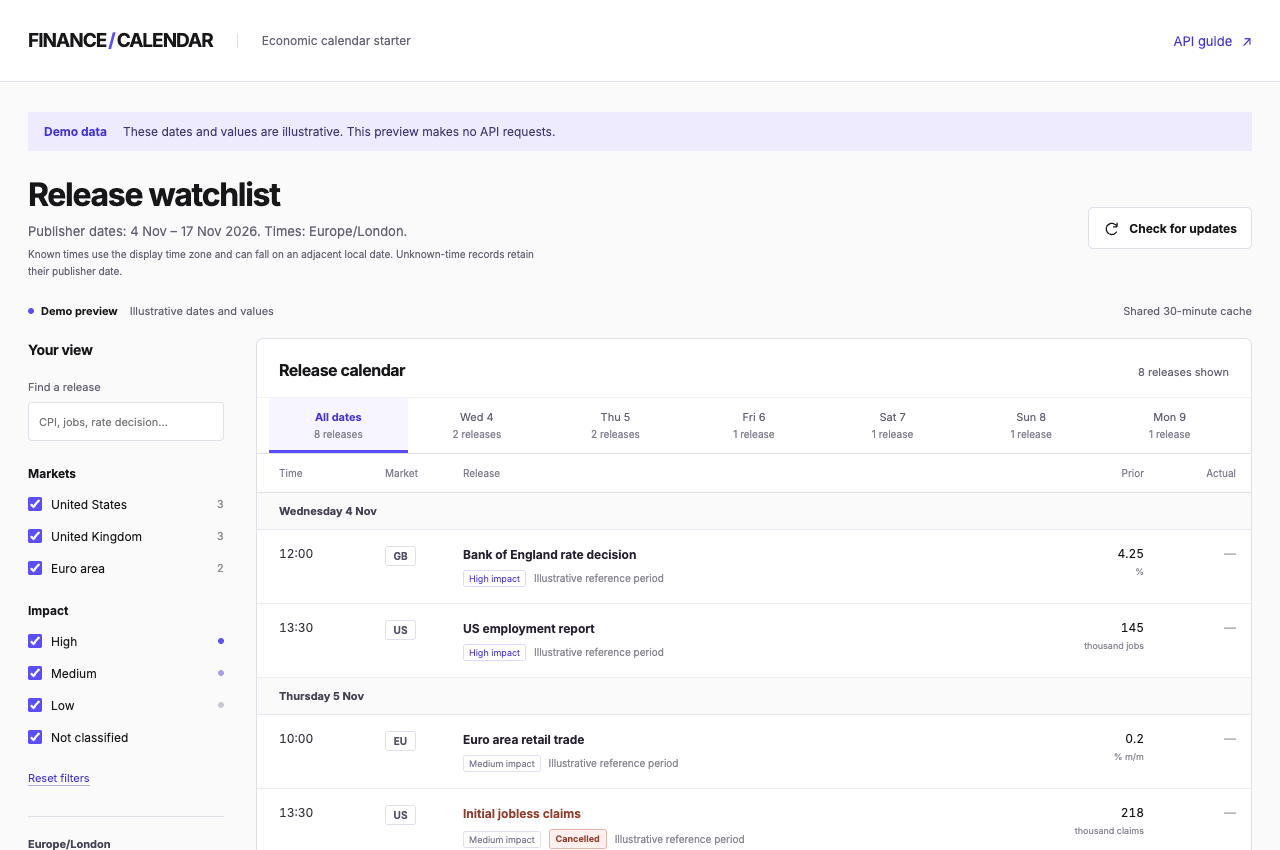
Build a calendar dashboard.
Start with a working Node backend, release calendar, browser filters and source details.
Run the sample locally
From a checkout of the public repository, open integrations/examples/economic-calendar-dashboard and run:
npm run demoDemo mode uses labelled illustrative data. Add your API key in your server environment to connect recorded data.
Build it with your AI coding assistant
Copy this brief, then provide your API key through your server’s private settings.
Build a source-aware release watchlist for people and AI research workflows.
Start from the working Finance Calendar dashboard:
https://github.com/awarenessdays/financecalendar-api/tree/main/integrations/examples/economic-calendar-dashboard

Read the public OpenAPI contract:
https://raw.githubusercontent.com/awarenessdays/financecalendar-api/main/openapi.json
MCP guide: https://www.financecalendar.com/api/mcp/
CLI and Python guide: https://www.financecalendar.com/api/cli/

Keep FC_API_KEY only in the server environment. Cache API responses and keep browser filters local where practical.
Preserve source credits,
unknown release times, null versus zero and stale-source flags. Keep demo records
clearly labelled. Run the starter's existing tests before changing its behaviour.Developer quickstart and response example
Make your first call.
Choose your access, verify your email and create a key. Free Developer provides the week-ahead schedule in JSON; paid plans add figures, wider dates and tools. Keep FC_API_KEY in your server environment.
curl "https://www.financecalendar.com/wp-json/fc/v1/calendar?country=US,GB&impact=high&limit=5" \
-H "X-API-Key: $FC_API_KEY"const response = await fetch("https://www.financecalendar.com/wp-json/fc/v1/calendar?country=US,GB&impact=high&limit=5", { headers: { "X-API-Key": process.env.FC_API_KEY } });
if (!response.ok) throw new Error(`Calendar HTTP ${response.status}`);
const { events, total } = await response.json();
console.log(total, events);import json, os
from urllib.request import Request, urlopen
request = Request("https://www.financecalendar.com/wp-json/fc/v1/calendar?country=US,GB&impact=high&limit=5", headers={"X-API-Key": os.environ["FC_API_KEY"]})
with urlopen(request, timeout=30) as response:
calendar = json.load(response)
print(calendar["total"], calendar["events"])Paid requests support JSON, CSV or ICS and up to 500 calendar records. Free Developer supports its two JSON schedule routes, up to 20 records per response within seven UTC dates.
Inside a calendar event
Recorded data{
"id": "us-industrial-production-november-2026",
"series_code": "us-industrial-production",
"country": "US",
"date": "2026-11-17",
"release_at_utc": "2026-11-17T14:15:00+00:00",
"release_tz": "America/New_York",
"time_precision": "minute",
"period": "2026-10",
"status": "released",
"consensus": "0.1",
"actual": "-0.4",
"prior": "0.7",
"unit": "% m/m",
"source_name": "Federal Reserve Board",
"source_url": "https://www.federalreserve.gov/releases/g17/",
"last_verified_at": "2026-11-23T02:42:40.907877+00:00",
"data_stale": false,
"source_license": null
}Selected fields from a real record in the current snapshot. Paid plans include the recorded numerical fields; Free Developer uses a separate schedule-only schema. Read the calendar endpoint reference.
Responses keep the reporting month, source evidence and timing precision alongside each value. A null field means no value is recorded; zero remains a value. API key limits and setup.
Questions about the data
How much historical data can I use?
The new official archive includes 1 year with Starter, 10 years with Build and all available history with Scale. Available dates vary by measure. These archive limits are separate from existing release history and curated datasets.
Are historical figures the original release values?
The official observation archive uses current recorded figures, which can include revisions. Original release figures and historical pre-release forecasts require separate evidence. Existing curated datasets and retained release history keep their own coverage and access.
When did the Finance Calendar API launch?
The Finance Calendar API launched on 31 August 2026. The site operator was incorporated on 20 December 2017 (UK company 11118824).
Coverage and sources
Connect the expanded US numerical feed with the release schedule, then inspect source context at field level. Explore the headline metrics and sources.
Release forecasts across 10 economies: Paid plans add a forecasts field for 60 headline measures in the US, UK, euro area, Germany, Canada, Australia, New Zealand, Japan, Switzerland and China: inflation, jobs, GDP, retail sales, business surveys and central bank rate decisions.
Each forecast is a Finance Calendar blend of market forecasts, refreshed through the day, frozen at release time and labelled with its update time and the number of independent sources behind it. Forecasts cover headline and core measures.
Expanded US release data: Eight more US series—CPI, nonfarm payrolls, PPI, retail sales, PCE inflation, ISM Manufacturing PMI, industrial production and Conference Board Consumer Confidence—join JOLTS, ADP employment, ISM Services PMI and Trade Balance. Bring consensus forecasts, actual and prior figures, reporting months and field-level source evidence into one integration across 12 US headline series.
For longer-run research, explore the official history archive and each measure’s available dates.
Stable event IDs keep watchlists, saved views and existing integrations connected as release data is refreshed. Use the same dataset through REST, hosted MCP, CLI and Python.
Field definitions, timing and reuse
The 12-series US numerical feed combines provider consensus with supported official and provider-backed actual/prior figures. Headline measures retain their units and reference periods. Values are populated from the evidence recorded for each occurrence; null remains distinct from zero. Source verification and build timestamps describe separate collection steps.
Known instants, date-only schedules, publication windows and estimates retain their timing precision. Recorded history includes provider backfill and current-vintage results; it does not establish original first prints or verified pre-release availability for every historical forecast.
Starter, Build and Scale all include API access for your own tools, apps and products. Preserve Finance Calendar attribution and publisher credits, source licences and reuse terms. See the API service terms, including earlier grants and independent source rights.
Snapshot window: 2025-11-23 to 2027-12-28. Individual series may cover less.
Built . Build time is separate from source verification.
Put the feed to work.
Build your first integration with Starter, or compare plans for more capacity and complete dataset downloads.
Full REST API reference · Expand the technical reference below for endpoints, filters, examples and attribution.
Try the US CPI and FOMC sample
Inspect a published US CPI inflation reading and scheduled CPI and FOMC release times with official sources. These publisher-selected records are frozen at the capture time below; this sample requires no account or API key.
Recorded sample captured at .
- Completed release — US CPI. Reporting period 2026-09. Release time (08:30 ET). Recorded actual 3.7 % y/y. Bureau of Labor Statistics.
- Scheduled release — US CPI. Release time (08:30 ET). No actual recorded at capture. Bureau of Labor Statistics.
- Scheduled decision — FOMC decision. Release time (14:00 ET). No actual recorded at capture. Federal Reserve Board.
An already connected hosted MCP client can also read this frozen example from feed_status, in structuredContent.recorded_public_sample when available. Preserve its capture time and source links; current service-health fields are separate. Hosted access uses your existing eligible account.
Sample guide and source fields · Recorded JSON sample
Prepare live access for the account owner
For a live next-US-CPI query, prepare a paid-plan setup with the current plan and billing interval below. Creating this two-hour setup needs no account or API key and does not create an account or charge the owner.
POST https://www.financecalendar.com/wp-json/fc-handoff/v1/setup
Content-Type: application/json

{"recipe":"next-us-cpi","client":"rest","plan":"starter","billing_interval":"month"}
Prepare a setup link in your browser. A person or browser-capable agent can select Prepare setup link there when the assistant cannot send the POST. Opening this preparation page creates nothing; the returned owner_url appears only after a successful request.
Set client to claude or chatgpt for that assistant, or use cursor, rest or cli. The setup preserves the next US CPI query; add FOMC after the account is connected.
- Share only the returned
owner_url. The owner signs in or registers, verifies their email, links the setup to their account, then selects Continue to Stripe to review and approve payment if needed. An owner with matching paid access can resume after linking. - Keep
status_tokenprivate. Poll the returnedstatus_urlusing theX-FC-Handoff-Tokenheader, no sooner thanpoll_after_secondsand beforeexpires_at. Follow the returnednext_action. - When
statusisready, useresume.connection_urlto connect with the owner’s account API key or supported MCP sign-in, then runresume.first_call. The first live query still requires the account’s paid access and authentication.
Full owner setup guide and status actions · Current API plans
API reference
The Finance Calendar API combines release forecasts for 60 headline measures across 10 economies and expanded consensus, actual and prior data across 12 US release series with economic-release schedules, central bank decisions and exchange holidays. Build through REST, hosted MCP, CLI or Python, and use JSON, CSV or ICS. Choose a plan, then connect the dates, figures and field-level source evidence to your workflow.
Open the full REST API reference, or expand the examples and usage details below.
API examples, authentication and usage details
Use one interface for a macro-event dashboard, research briefing, release-risk workflow or spreadsheet calendar. Expanded US numerical coverage adds consensus, actual and prior figures for CPI, payrolls, PPI, retail sales, PCE inflation, ISM Manufacturing, industrial production and Consumer Confidence alongside JOLTS, ADP, ISM Services and Trade Balance. Explore the headline metrics and source evidence.
Create an account, confirm your email and complete the activation steps shown in your workspace. Set FC_API_KEY in your server environment, then run:
curl "https://www.financecalendar.com/wp-json/fc/v1/calendar?country=US,GB&impact=high&limit=5" \
  -H "X-API-Key: $FC_API_KEY"
Read the API key setup guide or search the calendar in your browser. Use the same dataset through MCP for AI assistants, the CLI and Python client, or the REST endpoints below. Browse today and this week for a ready-made calendar view.
Open the Data explorer to search and filter calendar records and available numerical observations, inspect source evidence, and export matching results or selected rows as CSV or JSON. Create an account, confirm your email and complete the activation steps shown in your workspace.
See the current plans for Data explorer, saved-view and filtered-export access. API request allowances vary by plan; Scale also includes complete snapshot file downloads. REST, hosted MCP, CLI and Python require an API key.
Base URL
https://www.financecalendar.com/wp-json/fc/v1Production data routes, authenticated metadata and status routes, and hosted MCP require an API key. The OpenAPI schema (/openapi), current offer (/product-offer) and fixed recorded JSON sample (/sample) are public and require no account or API key.
Starter includes 250 data requests/day and 5,000 per calendar month, Build 100,000 per day and Scale 1,000,000 per day. Numerical data, wider routes and paid tools require an active paid plan; Free Developer permits its bounded schedule scope. Linked keys and hosted MCP data calls share that account allowance.
Check your usage response for the actual limit. Authenticated responses use private/no-store cache headers. Invalid parameters return HTTP 400; missing or invalid keys return HTTP 401.
Endpoints
| Endpoint | What it returns | Parameters |
|---|---|---|
/calendar |
Events in a date range, soonest first | from, to (YYYY-MM-DD, default today + 14 days, at most 92), country, impact, category, series, status, include=holidays, tz, limit (1 to 500), offset, format (json, csv, ics) |
/today |
Today’s releases, live NYSE status and any exchange closures today | country, tz |
/week |
This week, Monday to Sunday, or next week | which (this or next), country, impact, tz |
/next |
The next occurrence of a series | series (code, alias or keyword), country, tz |
/series |
Every series with code, aliases, country, impact and next date | country, category, kind (instance or holiday) |
/series/{code} |
One series: next, last, upcoming, history, long-run dataset where published | tz |
/history |
Recorded release history with consensus, actual and prior data where supported | series, from, to, limit, tz |
/history/observations |
Longer source-linked observations by measured reference-period start | metric_id or series_code, source_id, from, to, limit, cursor, order, as_of |
/history/releases |
Recorded official publication metadata by release date | metric_id or series_code, source_id, from, to, limit, cursor, order, as_of |
/history/coverage |
Measured stored history by exact source, series, metric and kind | metric_id, series_code, source_id, kind, limit, cursor |
/holidays |
Exchange holidays and early closes | exchange (nyse, sifma, sifma-uk, sifma-jp, cme, lse, tsx, asx, hkex, euronext, jpx, six, xetra, nse or all), year |
/market-status |
Is the exchange open now, with session hours and the next holiday | exchange |
/changes |
Change log: recorded changes to dates and values | since (ISO 8601, default 24 hours ago, at most 30 days), series, change (added, updated, removed), limit |
/countries |
Countries covered, with series and event counts | none |
/status |
Snapshot age and counts | none |
/openapi |
OpenAPI 3.1 description of everything above | none |
Filters
- country: US, GB, EU, DE, JP, CA, AU, CN, CH, NZ, NO, SE, IN, HK, comma-separated;
ukandeurozoneaccepted. - impact: high, medium, low. category: economic-indicators, central-banks-monetary-policy, market-holidays. status: confirmed, estimated, released, rescheduled, cancelled.
- series: codes or aliases from
/series(us-cpi,fomc,uk-cpi), comma-separated. - include=holidays: mixes market-holiday rows in; they are otherwise left out of
/calendar. - tz: an IANA zone such as Europe/London; adds
time_localfor known instants. Exact UTC and Eastern times are nullable. Date filters use the recorded publisher date; a converted local time may fall on another calendar day. - limit and offset: paging. List responses carry
countandtotal.
Examples
When is the next Fed decision?
curl "https://www.financecalendar.com/wp-json/fc/v1/next?series=fomc" \
  -H "X-API-Key: $FC_API_KEY"
When is the next UK CPI print, in London time?
curl "https://www.financecalendar.com/wp-json/fc/v1/next?series=uk-cpi&tz=Europe/London" \
  -H "X-API-Key: $FC_API_KEY"
Every high-impact US and UK release in the next two weeks:
curl "https://www.financecalendar.com/wp-json/fc/v1/calendar?country=US,GB&impact=high" \
  -H "X-API-Key: $FC_API_KEY"
What changed since yesterday:
curl "https://www.financecalendar.com/wp-json/fc/v1/changes" \
  -H "X-API-Key: $FC_API_KEY"
From your server-side JavaScript app (keep the key out of browser code):
const r = await fetch("https://www.financecalendar.com/wp-json/fc/v1/today", {
  headers: { "X-API-Key": process.env.FC_API_KEY }
});
const { market, events } = await r.json();
Response shape
Example response recorded on 19 October 2026 for /next?series=fomc. Dates and values change; run the request for the current response:
{
  "series": "fomc",
  "series_code": "fomc",
  "country": "US",
  "next": {
    "id": "fomc-rate-decision-october-2026",
    "series_code": "fomc",
    "series_name": "FOMC Rate Decision",
    "name": "FOMC decision",
    "title": "FOMC Rate Decision October 2026",
    "country": "US",
    "category": "central-banks-monetary-policy",
    "impact": "high",
    "date": "2026-10-28",
    "release_at_utc": "2026-10-28T18:00:00+00:00",
    "time_utc": "2026-10-28T18:00:00+00:00",
    "time_et": "14:00",
    "release_tz": "America/New_York",
    "all_day": false,
    "period": null,
    "status": "confirmed",
    "consensus": null,
    "prior": null,
    "actual": null,
    "unit": "% target range",
    "source_url": "https://www.federalreserve.gov/monetarypolicy/fomccalendars.htm",
    "source_name": "Federal Reserve",
    "url": "https://www.financecalendar.com/event/fomc-rate-decision-october-2026/",
    "exchange": null,
    "holiday_status": null,
    "close_time_local": null,
    "updated_at": "2026-10-19T16:02:05+00:00",
    "starts_on": "2026-10-27"
  },
  "attribution": {
    "source": "financecalendar.com",
    "terms": "Use is governed by https://www.financecalendar.com/api/terms/ and any separately agreed licence. Earlier grants and source-specific rights are preserved. Retain attribution and publisher notices.",
    "docs": "https://www.financecalendar.com/api/"
  }
}
The forecasts field adds a Finance Calendar blend of market forecasts for 60 headline measures across 10 economies, refreshed hourly, frozen at release time and labelled with its update time and source count.
The numerical fields combine provider consensus with supported official and provider-backed actual/prior values across 12 US headline series. Each value keeps its metric, reference period and field evidence. Individual occurrences may contain null values; zero remains a value.
Historical provider records may not verify pre-release availability or original first prints. Read the metric coverage and provenance guide for technical detail.
release_at_utc, time_utc and display-time fields can be null. Date-only rows retain the publisher date; null is not midnight. Published ranges use time_window_start and time_window_end, with time_precision="range". Do not present the range start as an exact release time. Treasury records with time_role="auction-close" identify the bidding close, not the publication of results. Reference period, release_stage and publisher-native IDs are included where recorded.
starts_on is set for multi-day meetings. exchange, holiday_status and close_time_local apply to market-holiday rows.
CSV and ICS
Add format=csv to a /calendar or /week query for a spreadsheet download, or format=ics for a calendar file. Download it with your header-authenticated client, then import the file into Google Calendar, Outlook or Apple Calendar. The examples below open API key setup with the selected request.
- October to December 2026, every release (CSV with API key)
- October to December 2026, high impact only (CSV with API key)
- October to December 2026, selected exchange holidays (CSV with API key)
- Fed, ECB, BoE and BoJ decisions through 19 January 2027 (ICS with API key)
- NYSE holidays 2027 (JSON with API key)
Google Sheets users should use the authenticated Apps Script guide; IMPORTDATA cannot attach the required API-key header. Schedule hubs link to API setup for series-specific downloads. Fetch an ICS file with your key, then import it into your calendar; do not put a key in a subscription URL.
Full dataset
The complete current calendar dataset is available as a JSON download on the Scale plan. Sign in to download the full dataset, or send your Scale API key in an X-API-Key header to GET /wp-json/fc/v1/account/full-export.
Each download checks your active Scale subscription; Starter and Build do not include the complete snapshot download. The export retains the recorded series, exchange table, source evidence and 30-day change log. The build workflow is scheduled hourly; inspect the file’s generation time and source status.
Filtered API responses remain available within your plan allowance. The OpenAPI spec and client code remain in the public repository at Finance Calendar API on GitHub.
API key setup
Programmatic data requests use an account key and the entitlement for the requested scope. Free Developer uses its successful-schedule-response allowance; paid keys share their existing admitted-request allowance.
Inspect the public data sample before creating an account. Create an account, confirm your email and complete the activation steps shown in your workspace, then choose “Create API key”. The full key is shown once. Existing issued keys keep working.
New keys are created in the verified account workspace; the former anonymous registration route returns HTTP 403:
Create an account to create a new key, or sign in to manage existing keys.
Send it as an X-API-Key or Authorization: Bearer header. Keep credentials out of URLs. Usage is at /keys/me; details on the key page.
Rate limits
For paid plans, daily and monthly quota usage counts admitted requests, not successful responses. Requests refused with HTTP 429 do not consume more allowance; a request that passes the quota check can still consume allowance if it later returns an error.
Free Developer instead counts successful committed HTTP 200 schedule JSON responses; invalid requests, denied requests and failures before commitment do not consume its successful-response allowance. Retained per-key request history remains a separate attempt diagnostic and can include rejected requests.
| Plan | Billing choices | Requests per UTC day | Requests per UTC calendar month |
|---|---|---|---|
| Starter | US$4.99/month or US$53.89/year | 250 | 5,000 |
| Build | US$9.99/month or US$95.90/year | 100,000 | No separate monthly cap |
| Scale | US$29.00/month or US$278.40/year | 1,000,000 | No separate monthly cap |
Annual prices are charged upfront; subscriptions renew until cancelled. Linked keys share account limits. Scale includes the complete current dataset download. Machine-readable current offer.
Daily limits reset at 00:00 UTC. Monthly allowances reset at 00:00 UTC on the first day of the next calendar month. Richer data and tools require paid access; Free Developer permits its bounded schedule scope; all linked keys share that plan allowance. Authenticated data responses carry X-RateLimit-Limit, X-RateLimit-Remaining, X-RateLimit-Reset and X-RateLimit-Tier. Compare current plans and availability on our API plans page.
Errors
API errors are JSON with an error message. Parameter errors also include a docs link. 400 is a bad parameter:
{
  "error": "tz must be an IANA timezone such as Europe/London or Asia/Tokyo.",
  "docs": "https://www.financecalendar.com/api/"
}
401 means an API key is missing or invalid. 404 is an unknown series or no upcoming event. 429 means the account has reached its daily or monthly allowance. The period is day or month; reset_at gives the applicable reset time and Retry-After gives the wait in seconds. All account keys share these limits. Wait for the indicated reset or review the plans at upgrade_url. There are no automatic charges; a paid plan starts only when you choose it and complete checkout.
Illustrative Starter monthly-limit response with a 1 December 2026 reset. Use the actual response’s reset_at and usage values in your application:
{
  "error": "Your account monthly allowance of 5,000 requests has been reached. All your keys share this allowance. Wait until 1 Dec 2026 00:00 UTC or upgrade at https://www.financecalendar.com/api/#plans. No automatic charges apply.",
  "code": "quota_exceeded",
  "period": "month",
  "scope": "account",
  "plan": "starter",
  "limit": 5000,
  "used": 5000,
  "remaining": 0,
  "reset_at": "2026-12-01T00:00:00+00:00",
  "upgrade_url": "https://www.financecalendar.com/api/#plans",
  "daily_limit": 250,
  "used_today": 1,
  "monthly_limit": 5000,
  "used_this_month": 5000
}
503 (“Calendar data is being rebuilt”) means retry in a minute.
MCP server, CLI and Python
The Node MCP server and CLI, and the Python client, use this same REST API. Start with the MCP setup guide or CLI and Python guide. Install financecalendar-mcp from npm or financecalendar from PyPI.
Build a working dashboard
Start from the economic calendar dashboard example: a complete Node backend and responsive browser view with no runtime packages. Try the labelled demo without a key, then connect your own activated account. The key stays on the server; a shared 30-minute cache and local browser filters reduce upstream API requests. Frequent restarts or multiple server processes can increase consumption.
Copy this into your coding assistant, then configure your key in the server’s private environment settings:
Use the economic-calendar-dashboard starter from
https://github.com/awarenessdays/financecalendar-api/tree/main/integrations/examples/economic-calendar-dashboard
Read its README and run its tests. Keep FC_API_KEY server-side, preserve the
shared 30-minute cache and failure cooldown, and filter locally in the browser.
Preserve source credits, unknown times, missing values versus zero and stale
flags. Keep demo records clearly labelled. Adapt the working app to my needs.
The REST reference and OpenAPI guide describe the HTTP contract. Fetch the public /openapi schema without an account or API key. The endpoint guide explains date filters, pagination, timezones and missing values.
Guides
Economic calendar, FOMC dates, CPI dates, jobs report dates, GDP dates, central bank calendar, market holidays, market status, forex calendar, widget, changelog.
Frequently asked questions
Can I use an ongoing free API?
Free Developer schedules: 100 successful HTTP 200 schedule JSON responses per UTC calendar month, up to 10 per UTC day, one key issued after approval of your request (allow up to 7 days for review), and no card or automatic paid subscription.
Use /calendar and /today for economic-release and central-bank schedules from UTC today through today+6, with country/impact filters, up to three country codes, optional dates narrowing that window and up to 20 records per response.
Responses identify truncation; pagination, numerical figures, history, other formats, hosted MCP and Data explorer require paid access. The allowance renews monthly. Free Developer covers personal use, internal tools and private development. Choose Build or Scale for customer-facing production.
Free Developer keys are issued after approval. Allow up to 7 days for review. Starter gives immediate access with recorded figures and paid tools.
Do I need an API key?
Production data routes, status and hosted MCP require an API key. The OpenAPI schema (/openapi), current offer (/product-offer) and fixed recorded JSON sample (/sample) are public and require no account or API key. Create an account, confirm your email and complete the activation steps shown in your workspace before creating a key. Your plan and usage response show your applicable allowance.
How fresh is the data?
Release schedules follow the hourly snapshot workflow, with dedicated collection refreshing mapped US numerical data and polling more frequently around supported release times. API responses use private/no-store cache headers. Query /status and inspect collection timestamps and field evidence for the releases you use; the coverage guide explains these technical signals.
Can I build an app for customers?
Yes. Build and Scale can power customer-facing sites, apps and services, including paid products, within plan limits and subject to attribution and applicable source terms. Starter and Free Developer are available for personal use, internal tools and private development. See the API service terms for scope, earlier grants and independent source rights.
Are earnings dates included?
No, because of upstream licensing. Economic data, central bank decisions and exchange holidays are all included.
Attribution and fair use
Attribution means a visible link to https://www.financecalendar.com near where the data is shown, or on your app’s about or credits page; “Finance Calendar” or “financecalendar.com” as link text is fine. You may cache and build on the data in your own tools, apps and products within your plan.
Keep the attribution object in any files you share, and retain publisher credits and source terms. The API service terms preserve earlier grants and rights independently supplied by original sources. Earnings dates are not included. Building something with this? We may feature it: get in touch.